Short, plain-language answers to the questions our guides hear every night.
Featured
Why Kp isn't the whole story
Kp is a planet-wide score from 0 to 9 for how disturbed Earth's magnetic field is. It's the number most aurora apps lead with, and it matters most for people far to the south, who need a big storm before the aurora reaches them.
Fairbanks is different. We sit right under the aurora oval, the ring where the lights live, so we can see aurora on quiet nights too. For us, what usually decides the night is what the Sun is sending right now: how fast the solar wind is moving, how dense it is, and above all which way its magnetic field points. When that field, called Bz, turns south, the door opens and energy pours into Earth's magnetic field. A Kp 2 night with a strong southward Bz can outshine a Kp 4 night with the door closed.
That's why ANN shows Kp beside the live solar wind, and why the satellite that measures the wind gives us roughly 30 to 60 minutes of warning before it reaches Earth.
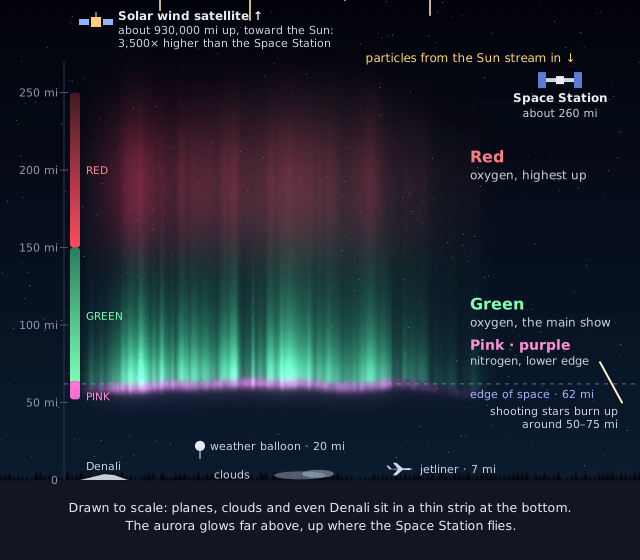
The aurora is a glow made by particles from the Sun. They stream down Earth's magnetic field lines and crash into the thin air 60 to 250 miles up. Each crash gives the air a jolt of energy, and the air lets it go again as light. The color depends on which gas gets hit and how high up it happens.
Swipe the chart to see it all →
Green: the classic
Oxygen about 60 to 150 miles up glows green. It's the most common color because that's where most of the particles stop, and because our eyes are most sensitive to green at night.
Red: the high glow
Oxygen higher up, above about 150 miles, glows deep red. The air there is so thin that the glow takes almost two minutes to happen, so it's usually faint. Strong solar storms can turn whole skies red.
Pink and purple: the lower edge
On lively nights, faster particles reach down to about 60 miles and hit nitrogen. That paints a pink, purple or blue fringe along the bottom of the curtains, often rippling fast.
Why do photos look more colorful than the sky? In the dark your eyes switch to night vision, which sees little color, so faint aurora can look gray-white or pale green. A camera collects light for several seconds and shows the colors that are really there. The brighter the display, the more color your own eyes pick up.